This page is build upon Converting the Open Data from the hbz to BIBO. We explain the mapping process from hbz MAB2 to our lobid.org datamodel which uses Bibo, Dublin Core and other Ontologies.
We took care of the considerations made in RDF representation of series and multi volumes .
Vocabularies
See the current list of vocabularies.
There are two namespaces in addition to the ones mentioned in Converting the Open Data from the hbz to BIBO :
@prefix wdrs: <http://www.w3.org/2007/05/powder-s#> .
@prefix isbd: <http://iflastandards.info/ns/isbd/elements/> .
and now we use the Prefix dcterms instead of dc for the namespace "<http://purl.org/dc/terms/>" .
Mapping of fields
Note: for convenience, if we speak of "field" we only give the field-ID, for example 037b_a would be <rdfmab:field/037b_a>.
We have mapped to fields from the record-centric RDF/ISO2709-format to a resource-centric BIBO-description as follows. Note that the original field names used below may contain wildcards for single characters (. and quantifier (?)as used in regular expressions).
Resource-URI |
The URI of the resource that is to be described is derived from identifier of the record, to be found in |
dcterms:title |
The title of the resource, combining main title and other title information. There will be only one dcterms:title. Sequentially the following fields will be used (if they are available): |
dcterms:language |
The language of the resource, found in |
dcterms:issued |
The year the resource was issued, sanity checked using |
dcterms:subject |
Subject-Links. These are derived from several fields:
|
bibo:issn |
The ISSN of the resource, found in |
dcterms:extent |
The extent of the resource, usually the number of pages, as found in |
rdf:type |
The type of a resource is derived from several fields, thus possibly resulting in multiple types for the same resource. The current mapping is a little a whole lot more elaborate since the start of lobid. org but will be subject of a further analysis. Have a look a the actual mapping fields .
|
bibo:volume |
The volume number of the resource, found in |
dcterms:isPartOf |
Fortunately, the original data already includes many links from subordinate to superordinate records which can be used to link the corresponding resources:
|
dcterms:creator |
|
dcterms:publisher |
There are a lot of fields, look at the mapping: {publisher_name}} is the name of the publisher and {publisher_place}} the place of the publisher. To conform to the range of the |
frbr:exemplar |
In the current state of the raw data, holding information is only implicitly available. Since the records are segmented into packages by instutition, we know that an institution is the |
The following predicates are totally new:
dcterms:format and dcterms:medium |
|
owl:sameAs |
For now there are some |
wdrs:describedby |
An URL to the local hbz-OPAC view is generated using the field |
dcterms:source |
There are a lot of fields, look at the mapping under |
isbd\:P1004 |
Main title of the resource. (Is used in parallel to dc:title (which combines main title and other title information). Sequentially the following fields will be used (if they are available): |
isbd\:P1006 |
The subtitle or any other remainder of the title of the resource. There can be many dcterms:alternative , coming from these fields |
bibo:isbn10 and bibo:isbn13 |
The ISBN 10 an ISBN 13 of the resource, found in |
dcterms:abstract |
That's the property we use in the rare but happily cases the fields of |
bibo:doi |
If field |
bibo:oclcnum |
Thats the field |
bibo:edition |
Thats the fields |
dcterms:source |
Thats the field |
dcterms:hasFormat |
All resources which are linked to through dcterms:source will be enhanced with that predicate, linking to the otehr resource so that here will be a reziprocal relation. As this information is sadly missing in the underlying datasets this triple will be produced after the complete data transformation (sigh ) (not yet implemented). |
dcterms:hasPart |
Thats the field |
The resulting model
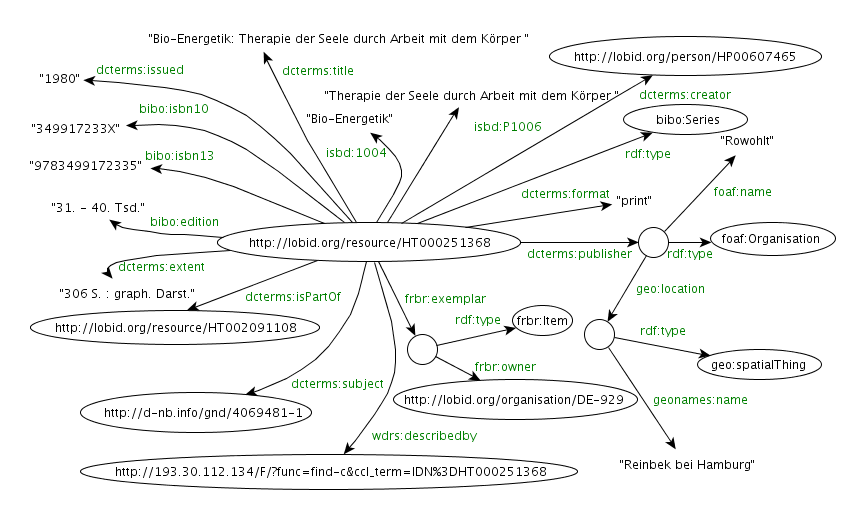
2 Kommentare
Adrian Pohl sagt:
05.09.2011Ich schreibe hier einfach mal rein, was mir so auffällt bei einigen Datensätzen:
dcterms:alternativescheint überfrachtet zu sein. Siehe etwa http://lobid.org/resource/HT004487006, wo auch die Serien-Angabe ("Suhrkamp-Taschenbuch Wissenschaft ; 1050") darunterfällt.More to come...
Pascal Christoph sagt:
06.09.2011zu dcterms:alternative : sollen wir die Angaben zum "Gesamttitel" (MAB 451-496) ganz ignorieren, da die Datensaetze ja sowieso verlinkt sind via dct:isPartOf ?
zur Überordnung : ich bekomme ja nur das geliefert was unter wdrs:described zu finden ist (da mal auf "Feldnamen" oder, für die MAB-Darstellung "Feldnummern" anklicken). Da also in dem Überordnungs-Datensatz "Philosophie der symbolischen Formen" keine Unterordnungen dranhängen gibt es das Wissen nur implizit (da die Unterordnunge tatsächlich mit der Überordnung verbunden sind). D.h. es müsste über eine externe Postprozessierung das implizite Wissen explizit an die Überordnung dranghehangen werden. Das geht natürlich prinzipiell, ist nur ein bisschen aufwendiger.